I design solutions by deeply understanding user needs, behaviors, and pain points—then translate those insights into clear, purposeful product decisions.
I design conversational flows and AI-powered interfaces that feel intuitive, human, and genuinely useful—bridging cutting-edge AI with real-world usability.
I deliver complete product experiences from initial research and wireframes through to polished, high-fidelity prototypes ready for development handoff.
I build and maintain scalable Figma design systems that keep teams moving fast, aligned, and consistently on-brand across every product surface.
About
I'm Leon Govier — a Lead Product Designer and UX leader with thirty years in digital, the last decade focused on fintech, specialist lending and B2B SaaS.
Print & Brand
Where it started
Press-ready artwork, brand identity, the discipline of getting it right before it ships
Web & Development
Learning to build
HTML, CSS, Flash — designing and building in the same breath for the first time
UX & Interaction
Following the user
Research, wireframes, usability — design stopped being about how it looks
Product Leadership
Leading the room
Design systems, squads, strategy — owning outcomes not just deliverables
AI-Native Design
Where I am now
Claude, MCP, code-first — thirty years of judgement, modern tooling
I work contract-based across the UK, embedded with product and engineering teams at Lead, Head of Product Design, and Technical Product Manager level. I've built UX functions from zero, led design systems adopted across enterprise platforms, and shipped AI-native products solo in four weeks. The range is deliberate — I move between strategy and execution because the best design leaders do both.
My workflow has shifted. I design in Figma, prototype in code, and use Claude and MCP to take layouts directly to production React components without fidelity loss. What used to take months takes weeks. That's not a shortcut — it's thirty years of judgement applied to better tools.
The work runs through fintech and regulated environments — mortgage calculators, broker CRMs, conversational quote engines, income verification platforms, design systems spanning four audience platforms at once. Complex products with real constraints, where design decisions have commercial consequences. That's where I'm most useful.
What I design
6 projects, one through-line — complex products shipped under real constraints. The variable is scale. Some are AI-native MVPs designed, prompted and built solo in a month — Cubik's lending platform, a reverse-matching CRM for a car dealer. Others are design systems absorbed into enterprise platforms already serving thousands — Jamf, CWT, Coincover. Fintech and specialist lending run through most of it; conversational quote engines, mortgage affordability, pricing calculators. Different domains, same job: make the complex usable.
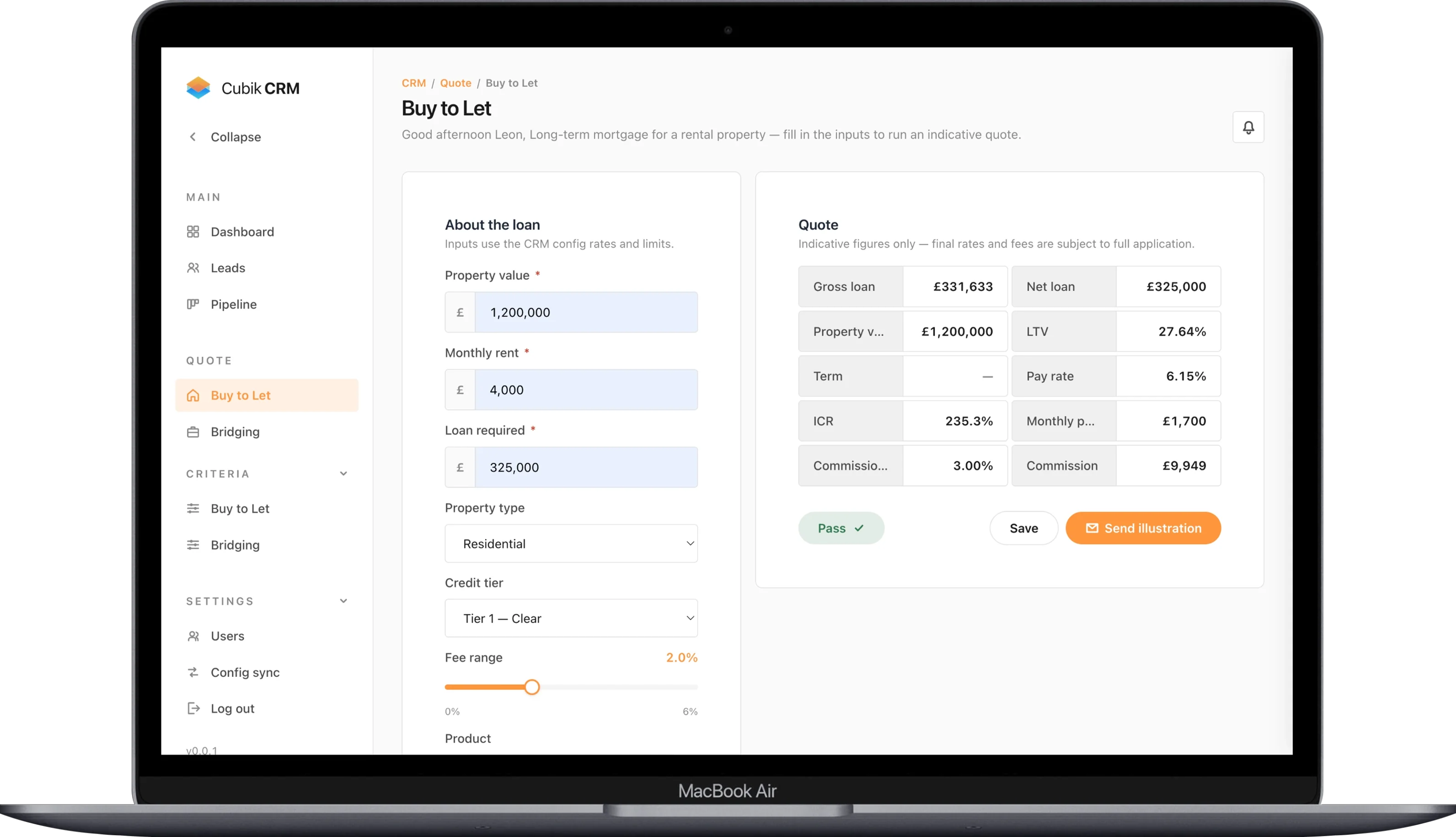
Cubik CRM turns broker enquiries into pipeline-tracked deals in a single workspace. Brokers generate indicative quotes for Bridging and Commercial Buy-to-Let in under 60 seconds using an embedded AI quote engine, then track cases from enquiry to completion without switching tools. Designed, prompted, prototyped and shipped as a four-week solo build using Claude Code as the full production pipeline.
Specialist lending brokers were managing cases across spreadsheets, calculators, and email — manually recalculating every quote when terms changed. Pipeline visibility was non-existent and data was lost at every handoff point between tools.
Tool selection is part of the design decision. Claude Design extracted brand tokens; Claude Code built the React frontend directly from Figma — no screenshots, no manual handoff. AI was the production pipeline, not a helper.
Cubik shipped as a connected workspace in four weeks. Brokers generate indicative quotes in under 60 seconds, track cases from enquiry to completion, and review full audit trails — without switching tools or context.
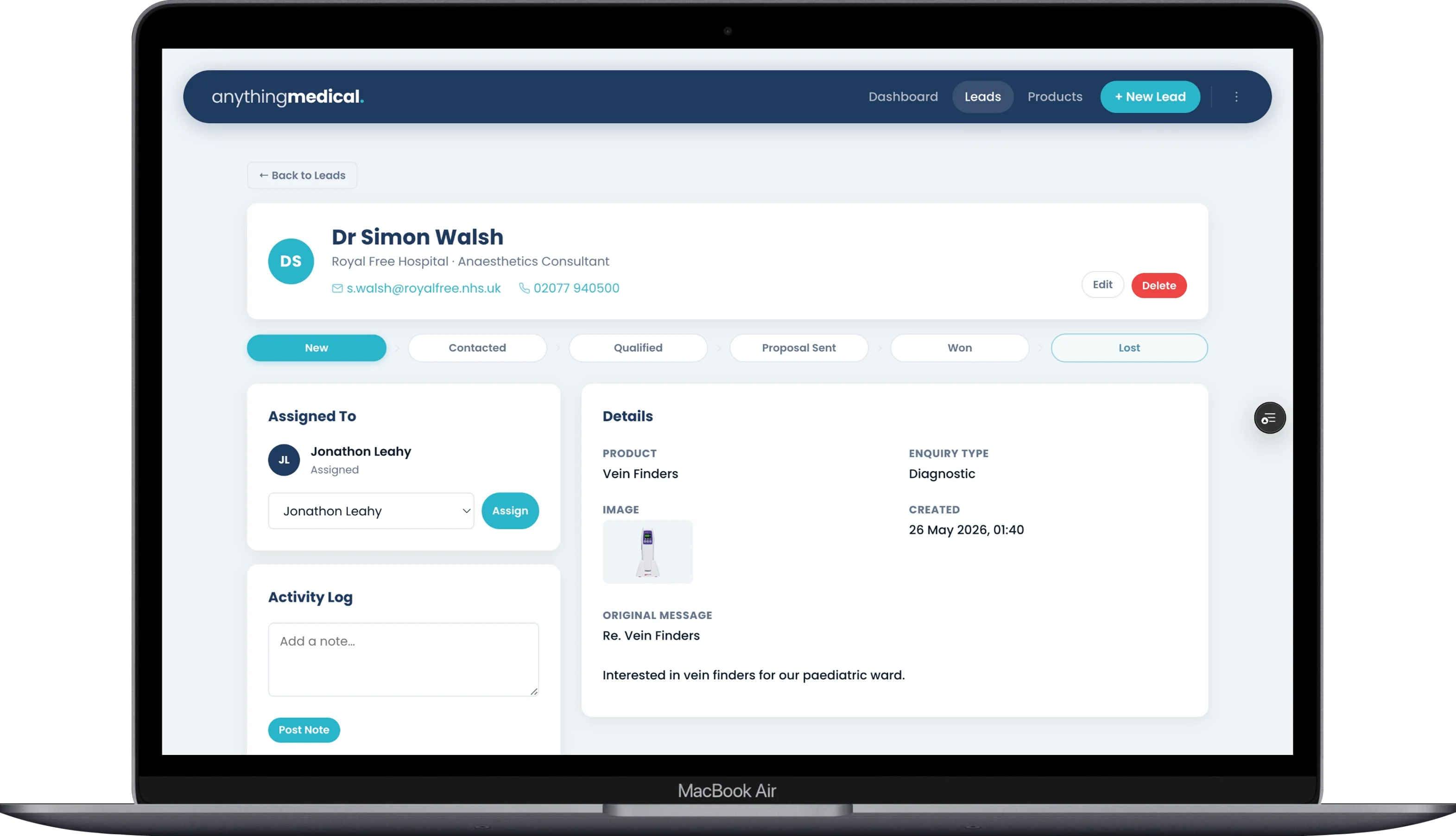
Anything Medical needed to replace a single-page WordPress site with no lead capture and no product detail. I built a 20+ page marketing site with a 16-product catalogue alongside a companion CRM — capturing every enquiry, routing it to the right sales rep, and tracking deals through a 6-stage pipeline. The client went from a phone and a spreadsheet to a live sales workflow on day one.
A one-page WordPress site with no product detail and no lead capture. Enquiries were tracked manually across email and spreadsheets.
Built without a framework to keep the frontend fast and fully owned. Next.js powers the CRM, using serverless API routes deployed on Vercel. Claude AI accelerated the entire build.
A full marketing site and CRM shipped in four weeks. Every enquiry now lands in a pipeline with the right rep automatically assigned.
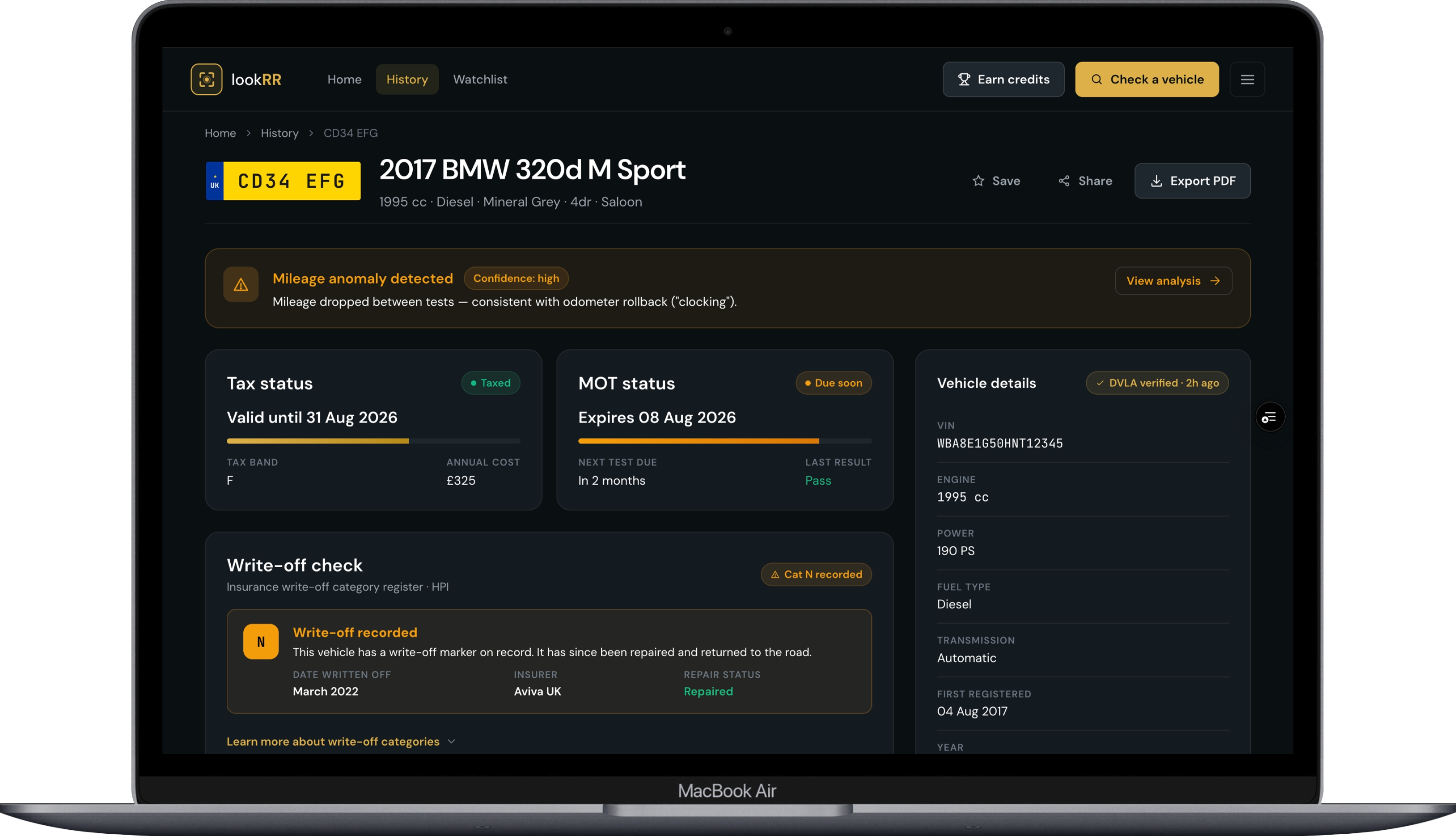
Lookrr gives UK motor trade professionals instant DVLA registration data, MOT history, HPI checks, and mileage fraud detection in under 2 seconds — all from a single plate search. No tab-switching, no manual cross-referencing, no missed red flags. Built as a full SaaS with tiered plans, a real-time dashboard, bulk CSV import, and a watchlist. Shipped production-ready with a complete design system, secure auth flow, and serverless API routes for live vehicle data.
UK dealers spend 5+ minutes per vehicle manually cross-referencing DVLA, MOT, and HPI sources. No single tool surfaces fraud signals alongside verified plate data instantly.
Built in vanilla HTML, CSS, and JavaScript — no framework, no build step. Claude Code drove the full design-to-deploy loop. Vercel handles hosting and serverless API routes for live vehicle data.
Shipped a full SaaS platform with auth, dashboard, bulk import, and watchlist — deployed live on Vercel. Vehicle checks return full MOT, tax, and fraud data in under 2 seconds.
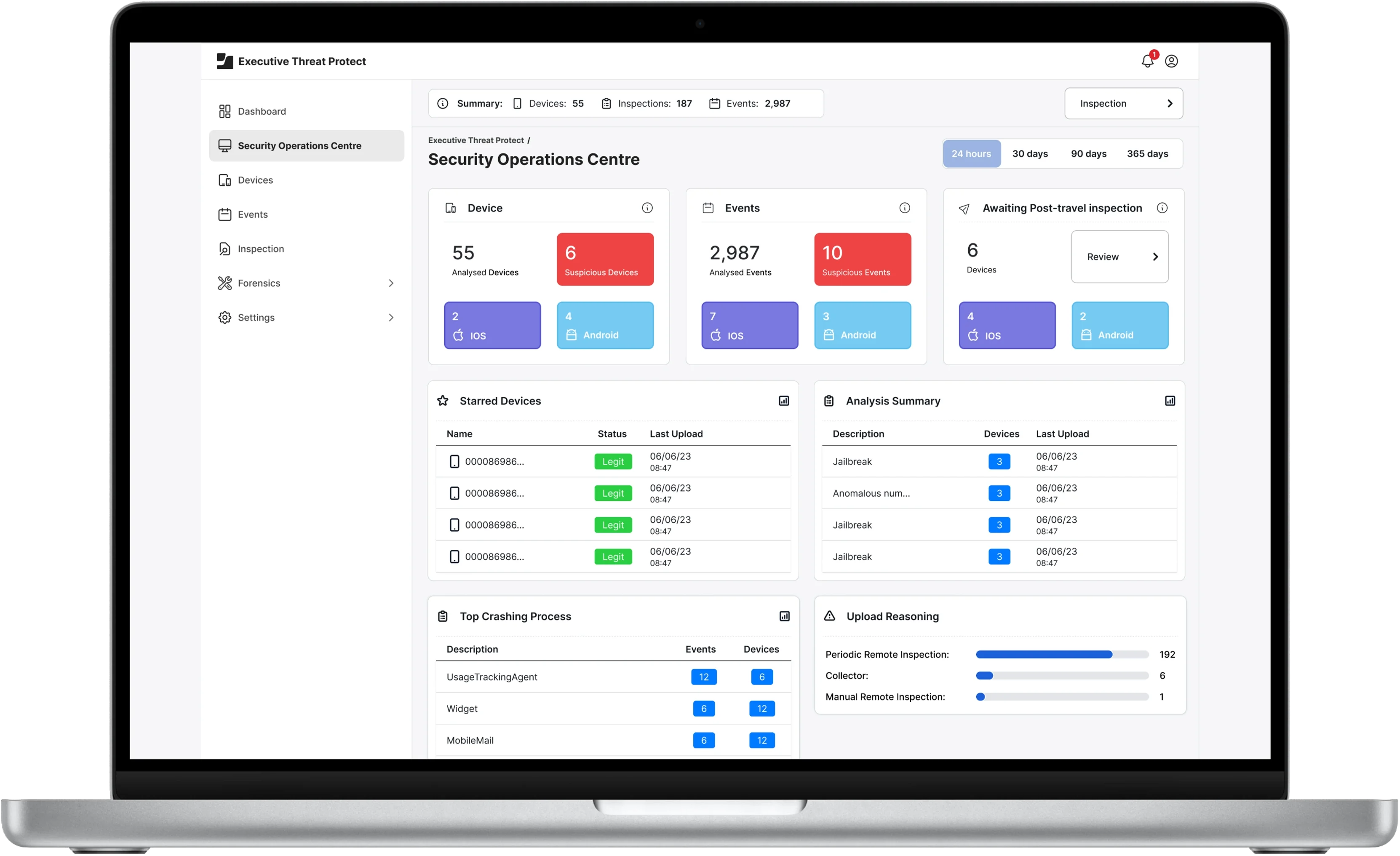
Jamf acquired a mobile threat defence platform with a completely different visual language. I absorbed the entire product into the Jamf design system as sole designer — maintaining the operational integrity security teams depend on, redesigning threat detection and incident response workflows, and contributing eight new component patterns back into the core system used across all Jamf products.
Jamf acquired a mobile threat defence platform with a completely different visual language and interaction model. Security operations teams using both products were context-switching between two distinct UIs — adding cognitive load at exactly the point where speed and accuracy matter most.
Embedded as sole designer for 8 months, working directly with the Jamf design system team and the ETP security product team to validate workflows against real threat scenarios.
ETP security console fully integrated into the Jamf design system. Security teams move between products without context-switching. Eight new component patterns contributed back to the core Jamf system, now used across other Jamf products.
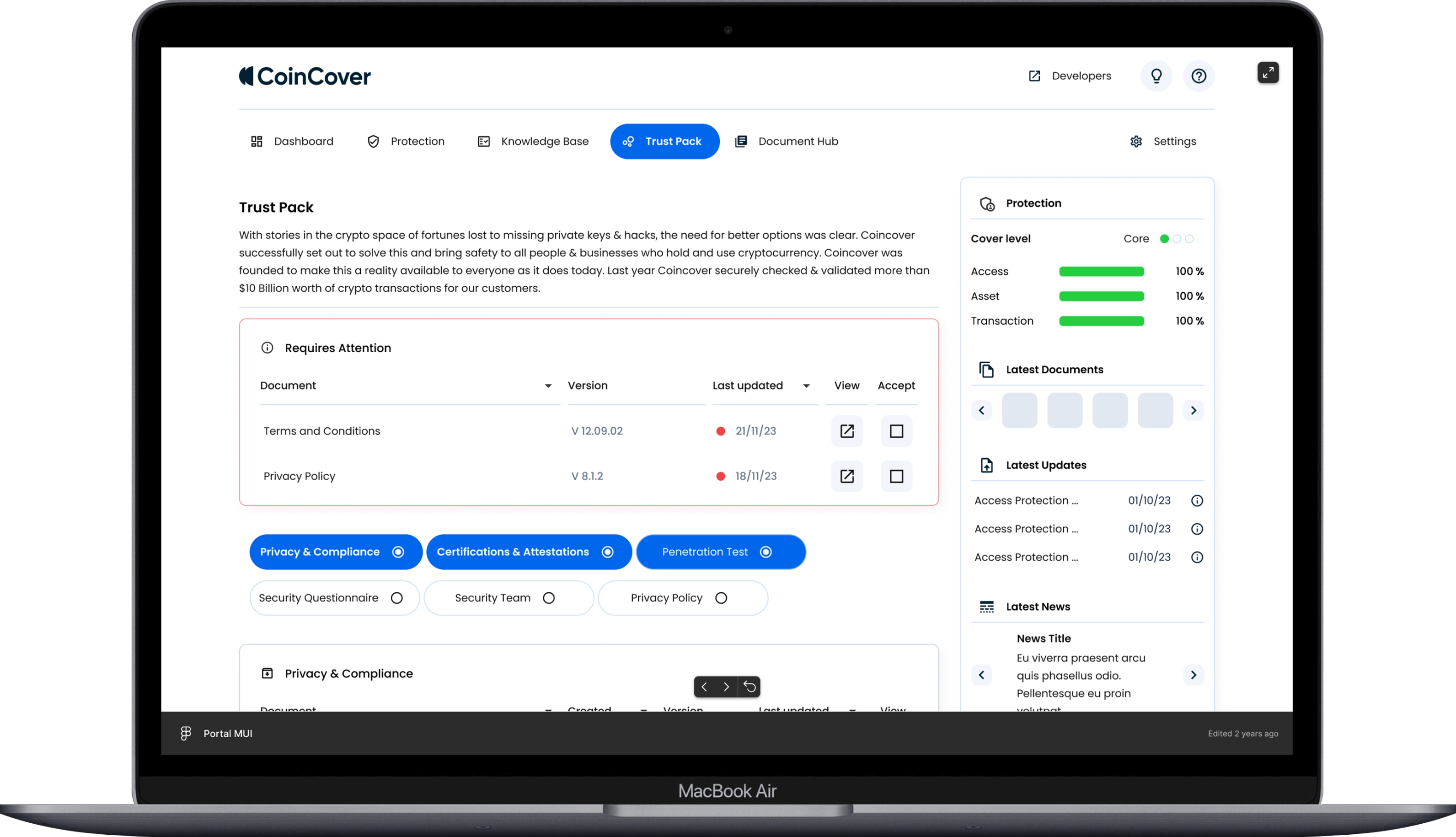
Coincover had four products, four visual languages, and zero shared infrastructure. I built a fully tokenised design system from zero — one component library spanning customer, partner, admin, and operations platforms — in four months. Brand updates that previously required four separate efforts now propagate across all products in minutes. The in-house team was self-sufficient within two weeks of handover.
Four separate products, four separate visual languages, zero shared infrastructure. Every brand decision had to be implemented four times. The design team was maintaining four Figma files with no shared styles — a single update required four separate design and development efforts.
Embedded for 4 months, building the token architecture, component library, and Storybook documentation in parallel — then running a structured handover programme to make the in-house team self-sufficient.
Production design system adopted across all four platforms from one component library. In-house team self-sufficient within two weeks of handover — extending the system independently from month one.
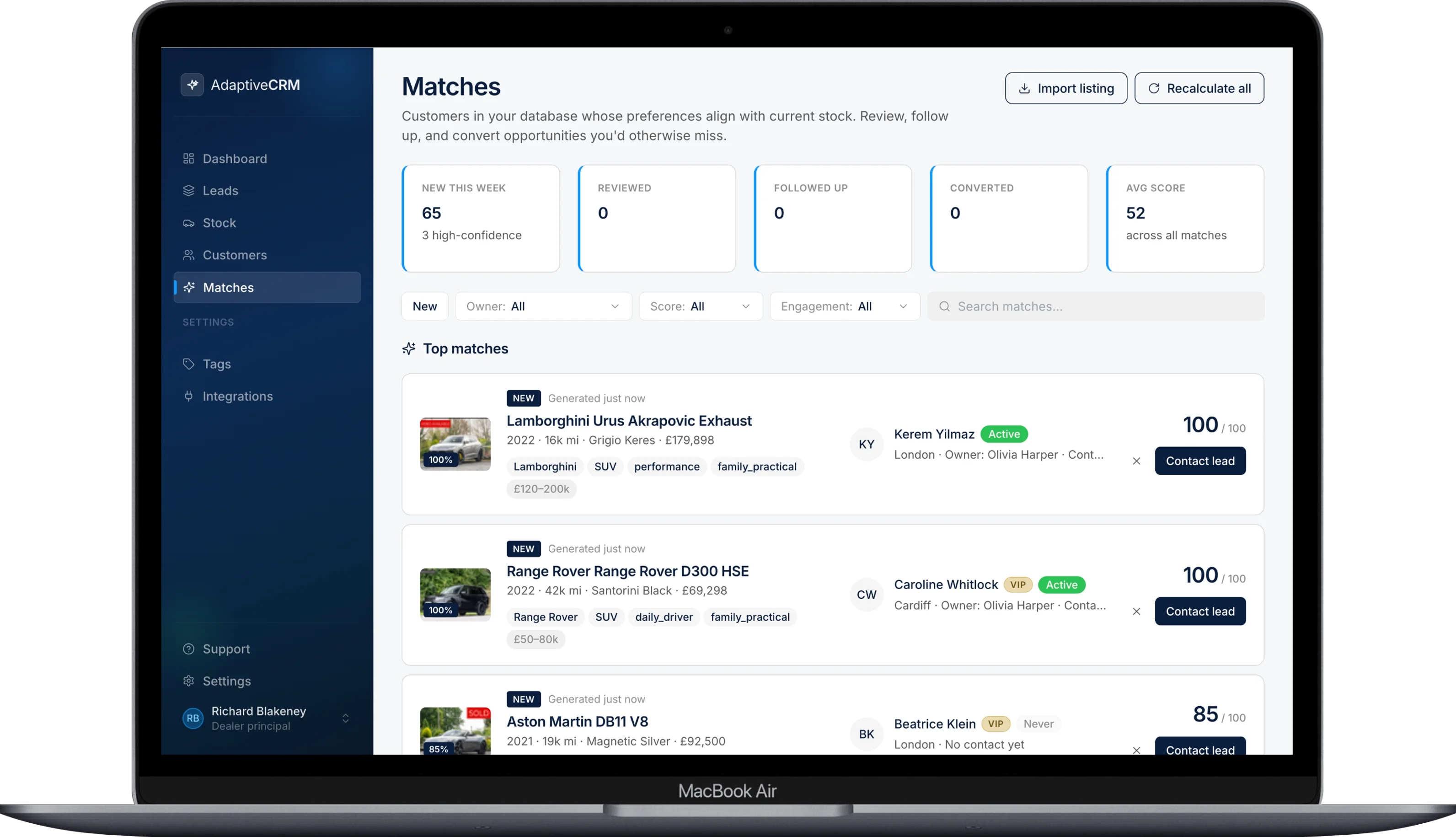
AdaptiveCRM reverses the usual workflow: instead of searching stock for customers, it searches customers for stock. A luxury-car dealer drops in a screenshot, photo, or WhatsApp message of a vehicle and AdaptiveCRM extracts the details, then ranks which customers in the database actually want it — in under ten seconds. Designed and prototyped for a UK luxury-car dealer exploring AI-native sales tools.
Luxury-car dealers find exceptional vehicles at auction but have no fast way to identify which customers would want them. The workflow relies on memory, manual CRM browsing, or blanket emails — slow, imprecise, and damaging to the client relationships luxury dealers depend on.
Solo build over 3 weeks. Claude API drives vehicle detail extraction from unstructured input and customer match scoring. Claude Code built the React frontend via MCP. Validated with a UK luxury-car dealer using real auction listings and their actual customer database.
Working prototype validated with a UK luxury-car dealer. Match scoring surfaced the right customers for the right cars. Transparent scoring breakdowns let dealers personalise outreach based on the specific match reasons — not just a ranked list.
Built for you
Production-ready digital products designed and shipped end-to-end — from AI-native tools and design systems through to calculators, CRMs and compliance workflows.
Complex financial calculators and AI-powered quote tools that turn broker enquiries into structured outputs in seconds. Built for specialist lending, mortgage and fintech environments where accuracy and speed both matter.
Broker and sales CRMs that connect quoting, pipeline tracking and case management in one workspace. Designed for teams running their business across too many disconnected tools and losing data at every handoff.
Token-driven component libraries built from zero and adopted across platforms. One source of truth flowing from Figma through MCP to production code — with governance and documentation that lets teams extend them independently.
Conversational interfaces, agent-based workflows and human-in-the-loop tools built for regulated environments. Designed where the AI is a first-class part of the experience — not a feature bolted on after the fact.
Internal and customer-facing dashboards across complex data domains — built with accessible visualisation systems that non-specialist teams can extend. Five domains shipped from one analytics design system at CWT.
Guided digital workflows that replace paper-based processes in regulated environments. Built for mortgage income verification, educational compliance and healthcare — where mandatory validation and audit trails are non-negotiable.
Process
Good product design happens between people, not in isolation. I embed in teams, work through ambiguity alongside engineers and stakeholders, and keep the process visible at every stage — no black boxes, no surprises at handoff. Here's how that typically looks from first conversation to something live in the wild. AI accelerates the parts that should be fast — never the parts that require judgment.
01 / Discover
Sit with the team and the users. Map constraints, workflows, the messy reality — not the polished version. The real signal lives in the conversations, not the brief. AI helps synthesise interview transcripts and surface patterns across sessions faster — but the judgment about what actually matters still happens in the room.
02 / Define
Synthesise what research actually says, not what everyone assumed it would. AI helps stress-test assumptions and spot contradictions in the data before they become design debt. Kill scope that doesn't serve the core job. Alignment here — whether it takes a week or three — saves months later.
03 / Develop
Design in Figma — components, tokens, layouts, flows. Claude Design extracts brand tokens; Claude Code builds working components directly from layouts, removing the manual translation step entirely. Multiple review cycles still happen — AI accelerates the gap between prototype and production, it doesn't skip it.
04 / Deliver
Pair with engineers through QA, polish the details, then watch it in the wild. AI helps catch edge cases and generate test scenarios faster — flagging regressions and surfacing what manual review tends to miss — but the final call on what ships is always a human one. Shipping well means staying close until it's truly done.
Skills
Thirty years in digital, the last decade focused on product design leadership across fintech, SaaS and regulated environments — from discovery and research through to shipped, production-ready products.
How I build and lead design teams — establishing the culture, process and operating model that lets designers do their best work.
Experience
Approach
How I connect design decisions to business outcomes — from shaping roadmaps and defining success through to facilitating discovery and keeping scope honest.
The sectors and product types I know deeply enough that domain expertise replaces research time — I understand the constraints before the brief lands.
How I close the gap between what's designed and what ships — using AI-assisted pipelines that take Figma layouts to production components without fidelity loss.
Qualifications
Process
How I work inside product and engineering teams — from sprint planning and backlog refinement through to stakeholder reviews and regulated release cycles.
The full stack I use to design, build and ship — from component libraries and design systems through to deployment pipelines and production environments.
From early wireframes to polished, production-ready components. The tools I use to design, prototype and build at every fidelity.
Product design leadership across fintech, SaaS and regulated environments — from discovery through to shipped.
Designing AI-enabled products where the model is a first-class part of the experience.
Feedback received
Recommendations gathered over the years from the people on the other side of the work — chief officers, product directors, design leads and engineers. Different companies, different briefs, but the themes recur: clarity under pressure, design that holds up after launch, and someone equally at home in a stakeholder room or deep in the detail. Their words, not mine.
Leon has led a wide range of transformation initiatives across systems, process and governance. He combines genuine diligence with strong product judgement and a clear solution-orientated mindset. He is equally comfortable rolling up his sleeves to resolve detail-level issues as he is operating in senior forums, where he communicates with clarity and confidence.
Leon is a driving force for change with the ability to translate business requirements into best in class UX. A passion for excellence is abundantly clear which, when aligned to his collaborative approach, outputs always exceed expectations. Leon is comfortable working to tight deadlines within high change environments applying the principles of agile implementation.
It pains me to say this because I want to keep Leon all to myself, but I cannot recommend him enough. A calm, composed influence within the team, bringing structure to the UX design process, and the end product — what can I say. There's no hipster, trendy stuff here; this is solid, well thought out design where everything serves a purpose.
Leon has a passion and dedication for his work which I have seldom seen or experienced in other colleagues. A track record for consistent high quality delivery against demanding timescales and always looking to innovate. A leader and role model for his team in the field of UX, always challenging them to learn new skills. Never afraid to speak his mind and challenge the status quo, but always focused on delivery.
Leon worked on the design of a web-app which was being rearchitected to run as a Single Page Application. Leon's focus extended well past the pure UI into the user journeys, and overall UX, culminating in a much cleaner, much more user-friendly application. His approach of working directly with the end users to understand their pain points allowed us to focus on what was important to them, aiding adoption and resulting in a product that runs on over 90% of devices.
Leon brought a wide range of UX and UI Design experience to TrakCel and over the term of a short contract was able to quickly engage with the team and went beyond expectations in delivering benefit to the design of the product and influence to the future direction of UX, design and development in the organisation. The experience, team-orientation and urgency that Leon brings to his work would be a welcome addition in any product team.
Leon came into Hills to head up the visual design team. He performed exceptionally in hiring and managing the team, while delivering the high quality of work the business needed. At the same time he built strong relationships across the business and worked effectively with a wide range of stakeholders and peers. He would be an asset to any digital business.
Leon provides me with nothing but support and guidance when I need it. He passes down his wealth of User Experience and Design knowledge for which I will be grateful. His management skills are very good and has built a culture where my colleagues and I can thrive. I wouldn't hesitate giving Leon my full recommendation to anyone.
I have worked with Leon directly, he supported me on product launches; he has essentially dressed the shop window for the company. To this end, Leon has been spectacular. I quickly learned to be less prescriptive and let Leon's experience and creative flair provide relevant, current and workable solutions. Leon has always provided forward looking solutions which extend beyond the current project.
Leon was instrumental to our ability to deliver a high quality product to the market. He first identified gaps in existing UX processes, then provided an end-to-end solution to improve understanding of business requirements and communicating final designs to development teams. His expertise in UI/UX is self-evident, and on top of this he is an excellent collaborator, communicator, organised, and does what he says.
I had the pleasure of working with Leon at CWT, where he significantly improved our UX-to-development handoff. By implementing a Material UI design system and driving full adoption across design and engineering, he brought consistency, clarity, and scalability to our workflow. This streamlined delivery, reduced rework, and improved collaboration between teams. Leon's ability to align design with real-world implementation had a clear and lasting impact on how we build products.
Leon is a great addition to any team and I couldn't recommend him enough. During a short-term contract, he successfully designed and delivered a high-quality customer portal that put our customer's needs at the forefront, and improved our design to developer handoff process. Leon brings with him a wealth of UX and UI experience which he is always happy to share.
FAQs
You might have questions about working with me. If what you need isn't answered here, please reach out directly.
I work on product design, design systems, AI-native experiences and cross-functional delivery — usually embedded with product and engineering teams in fintech, SaaS or regulated environments. I take on leadership roles (Head of Product, UX Lead), senior IC positions, and delivery consulting where design maturity or velocity needs improvement. I don't do branding, marketing sites, or one-off logo work.
I embed as part of the team — either leading design direction or working hands-on as a senior IC. I work contract-based (day rate or fixed scope), on retainer for ongoing support, or fractionally for smaller teams that need consistent design leadership without a full-time hire. I'm comfortable in Agile, SAFe, or custom delivery models.
I work hybrid. I'm based in Cardiff with regular availability in London, and I'm set up for effective remote collaboration across distributed teams. I'm flexible for on-site days, sprint planning, workshops or stakeholder sessions when face-to-face adds value. Most of my work happens remotely with intentional in-person touchpoints.
I follow Double Diamond — Discover, Define, Develop, Deliver. What changes project-to-project is phase weighting and tooling. I use Figma for design, Claude and MCP for AI-assisted delivery, and work directly with engineers to ship production-ready components. Discovery and research stay human-paced; design-to-code is where AI compounds velocity.
Yes. I have strong front-end fluency (HTML, CSS, JavaScript, React) and use AI-assisted workflows to go from Figma to production code. I'm not replacing engineers — I'm accelerating handoff quality and reducing translation loss. I can prototype, build design systems, or ship MVPs when speed matters.
Extensively. I design AI-native products (conversational UX, human-in-the-loop workflows, LLM-assisted experiences) and use AI in my delivery process (Claude, MCP, automated testing). I'm particularly experienced in regulated environments where AI needs guardrails, transparency and human oversight.
Fintech, lending, SaaS, healthcare and regulated platforms. I understand compliance constraints, complex workflows and high-stakes user journeys. I've designed mortgage platforms, trading tools, CRM systems, analytics dashboards and AI-enabled lending products. If your domain is complex and regulated, I've likely worked in something similar.
It depends on scope. Short-term contracts run 4–12 weeks (design system setup, product redesign, discovery sprint). Longer engagements are 3–6 months (Head of Product, embedded design lead). Retainers are ongoing. I'm flexible and scope work to match your delivery cadence and budget.
Day rates vary based on scope, duration and engagement type. I'm transparent about pricing and structure proposals around outcomes, not hours. For fixed-scope work, I provide a clear estimate upfront. For ongoing work, we agree on a retainer or day rate. Get in touch and I'll send a proposal.
Both. I build scalable design systems (components, tokens, documentation, governance) aligned to your tech stack — whether that's React, Angular, Salesforce LWC, or custom. I also lead end-to-end product design from research through delivery. Often both happen together: designing the product while establishing the system to scale it.
Yes. I've led UX transformation in fintech and SaaS orgs — introducing research practices, design ops, better tooling and cross-functional workflows. I mentor designers, upskill teams on Figma, Storybook and delivery processes, and help product and engineering teams raise design quality without slowing down.
Let's talk. I start most engagements with a discovery conversation — understanding your product, team structure, delivery challenges and goals. From there, I'll recommend the right scope: whether that's hands-on IC work, design leadership, systems thinking, or process improvement. No obligation, just clarity.